
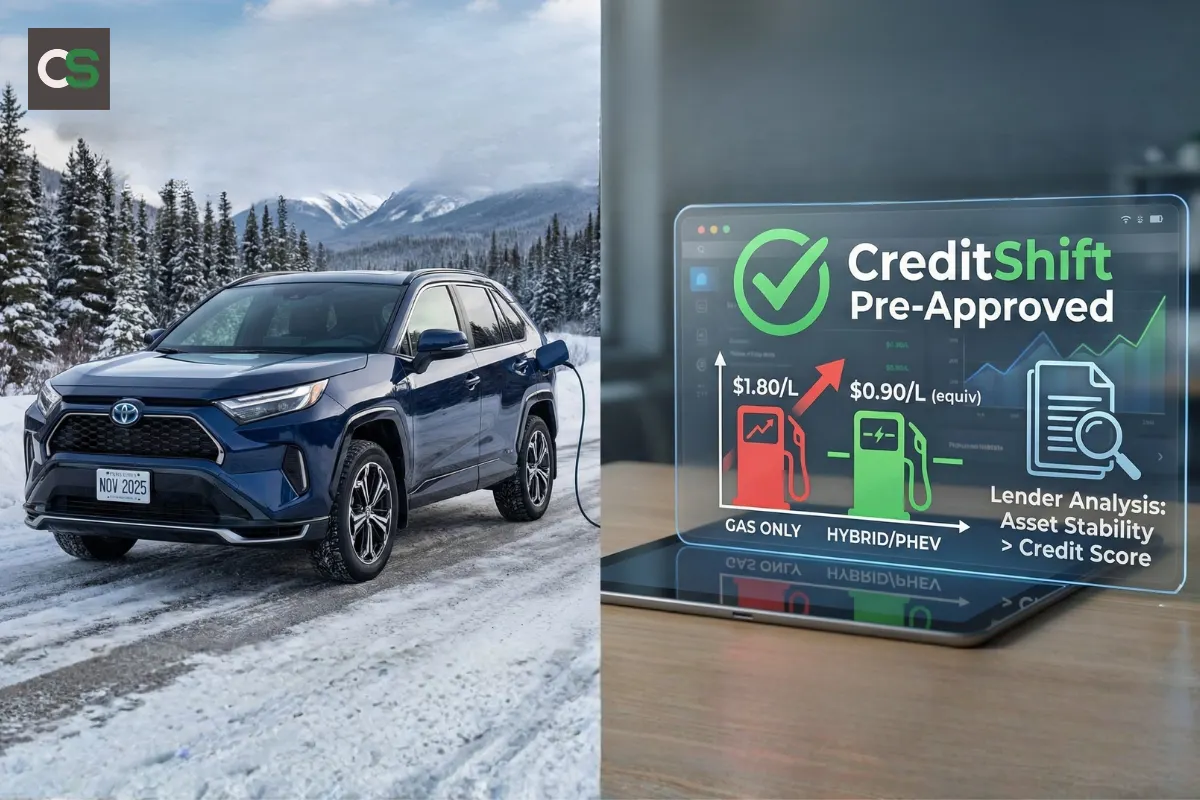
You want the AWD capability for Canadian winters and the fuel savings of a hybrid, but you are worried your credit score will hit the brakes on your financing. You are not alone.
By late 2025, the Canadian automotive landscape has shifted dramatically. With the Federal iZEV rebate paused and several provincial incentives ending, the “easy money” era of hybrid buying is over. However, for borrowers with bad credit (sub-660 score), the Hybrid SUV remains the single most powerful tool to secure an auto loan approval.
Why? Because lenders are no longer just looking at your credit history, they are looking at the asset’s stability.
This guide cuts through the confusion of Hybrid SUV financing in Atlantic Canada. We will move beyond the “rebate hype” and show you the advanced financial mechanics – Loan-to-Value (LTV) ratios, Total Cost of Ownership (TCO), and Fuel Solvency – that specialized lenders use to approve you, even when the big banks say no.
1. The Financial Logic: Why Lenders Love Hybrids (Even for Bad Credit)
To get approved, you need to understand how a lender thinks. In the subprime market, approval is a calculation of risk.
The “Asset Stability” Factor
Lenders are terrified of Negative Equity – where the car is worth less than the loan balance.
- Gas SUVs: In 2025, gas-only vehicles are depreciating faster than ever due to volatile carbon taxes and fuel prices. A lender sees a gas SUV as a “risky asset.”
- Hybrid SUVs: Demand for used hybrids is at an all-time high. A Toyota RAV4 Hybrid or Mitsubishi Outlander PHEV retains nearly 75% of its value after 3 years.
The Semantic Win: This high resale value creates a favorable Loan-to-Value (LTV) ratio.
If you have a credit score of 580, a lender might reject you for a $40,000 gas Ford Edge because its value will drop like a stone. But they might approve you for a $45,000 Hybrid SUV because the collateral is secure.
“Fuel Solvency”: The New Debt Ratio
Sophisticated lenders now use AI to calculate your Fuel Solvency.
- Scenario A: You buy a gas truck. Payment: $800. Gas: $400. Total monthly burden: $1,200.
- Scenario B: You buy a PHEV SUV. Payment: $900. Gas/Hydro: $100. Total monthly burden: $1,000.
Even though the Hybrid payment is higher, your Total Cost of Ownership (TCO) is lower. Lenders know you are less likely to default on a car that doesn’t bankrupt you at the gas pump. This improves your Debt-Service Coverage Ratio (DSCR).
2. Vehicle Classification: Which Hybrid Fits Your Financing?
Not all hybrids are treated equally by finance companies. Understanding the distinction is critical for your budget and approval odds.
Full Hybrid Electric Vehicles (HEV)
- Definition: Uses a gas engine combined with regenerative braking. Cannot be plugged in.
- Popular Models: Toyota RAV4 Hybrid, Honda CR-V Hybrid, Hyundai Tucson Hybrid.
- Financing Profile: Treated like a standard vehicle.
- Best For: Drivers with no access to home charging (apartments/condos).
- The 2025 Reality: Zero government rebates available, but they have the highest resale value of any vehicle class, making them the easiest to refinance later.
Plug-In Hybrid Electric Vehicles (PHEV)
- Definition: Larger battery, plug-in capability, 40 – 80km electric range.
- Popular Models: Mitsubishi Outlander PHEV, Kia Sportage PHEV, Toyota RAV4 Prime.
- Financing Profile: High upfront cost, but eligible for the remaining provincial rebates (QC, PEI, NL).
- Best For: Homeowners or renters with garage access who drive <50km daily.
Mild Hybrid (MHEV)
- Definition: A small 48V battery assists the engine (e.g., Ram 1500 eTorque, Volvo B-series).
Financing Profile: Lenders view these as Gas Vehicles. They do not offer the same LTV benefits or fuel solvency advantages as true HEVs or PHEVs. Avoid these if your primary goal is to leverage “Green” approval criteria.
3. The 2025 Rebate Landscape: The “Cliff” Has Arrived
Critical Update (November 19, 2025): The financial landscape has changed. The Federal iZEV program is currently paused due to funding exhaustion. Do not rely on old blog posts promising you $5,000 from Ottawa.
Here is the accurate status of rebates you can use as a down payment today:
|
Region |
Program Status (Nov 2025) | Max PHEV Rebate |
Notes |
|
Federal (Canada) |
🔴 Paused |
$0 |
Funds committed. Waitlist only. |
|
Nova Scotia |
🔴 Ended |
$0 |
Ended May 2025. |
| New Brunswick |
🔴 Ended |
$0 | Ended July 2025. |
|
BC (CleanBC) |
🔴 Restricted |
$0 – $1,000 |
Highly income-tested or fully allocated. |
|
Quebec (Roulez Vert) |
🟡 Phasing Out |
$1,000 – $2,000 |
Amounts reduced Jan 2025. Ends 2027. |
|
PEI |
🟢 Active |
$2,000 |
Valid for eligible PHEVs. |
|
Newfoundland (NL) |
🟢 Active | $1,500 |
Program active until March 15, 2026. |
The Strategic Pivot: If you live in Ontario, Alberta, or the Maritimes (NS/NB), you must stop looking for “Free Money” and start looking for “Green Loans” from private lenders.
4. Green Loans & Private Lender Incentives
With government rebates drying up, the private sector has stepped in. Several Canadian financial institutions offer “Green Vehicle Programs” that can lower your Cost of Borrowing (COB).
The “Green Rate” Discount (Prime Credit: 700+)
Major banks offer interest rate reductions for Hybrids to meet their ESG (Environmental, Social, and Governance) targets.
- CIBC Green Vehicle Program: Offers specialized rates for HEV, PHEV, and EVs.
- Scotiabank: While rates vary, they prioritize financing for newer, fuel-efficient models.
- RBC: Offers “Clean Energy” financing options that can sometimes waive certain lender fees.
The “Stability” Approval (Subprime Credit: <660)
If you are using CreditShift to find a loan, we work with non-prime lenders (like Santander, Fairstone, or General Bank) who don’t offer “Green Rates” but do offer “Green Approvals.”
- Extended Terms: Because Hybrids last longer (Toyota hybrids often hit 300,000km), subprime lenders are willing to extend loan terms to 84 or 96 months.
Why do this? A 96-month term on a gas car is risky. On a Hybrid, it lowers your monthly payment significantly while the car remains reliable, keeping you on the road and employed.
5. Top 3 Hybrid SUVs for Bad Credit Approvals
We analyze vehicles based on Inventory Availability and Lender Approval Odds in late 2025.
1. Mitsubishi Outlander PHEV
- The Subprime King: Mitsubishi has historically been the most aggressive manufacturer for approving challenger’s credit.
- The Asset: It has a 10-year powertrain warranty. Lenders love this because it means a major engine failure won’t cause you to default on your loan in Year 4.
- Strategy: Look for a 2023-2024 Certified Pre-Owned (CPO) model to avoid the steep depreciation of a brand-new unit.
2. Toyota RAV4 Hybrid (Not Prime)
- The Safe Bet: This is the “Gold Standard” of collateral.
- The Problem: Wait times are still 6+ months for new ones.
- The Fix: Lenders will heavily finance a used RAV4 Hybrid (2020-2022) because they know it will still be worth $20,000 when your loan is paid off. It allows for a “low-risk” subprime loan.
3. Hyundai Tucson Hybrid
- The Value Pick: Offers high-tech features for a lower MSRP than Toyota.
Approval Note: Hyundai Finance has tightened its criteria in 2025, but third-party lenders still favor this model due to its strong warranty.
6. How to Structure Your Deal: The “CreditShift” Blueprint
If you have bad credit, do not just walk into a dealership and ask for a loan. You will get hit with hard credit checks and high rates. Follow this semantic blueprint:
Step 1: The “Soft Pull” Pre-Qualification
Use a platform like CreditShift to perform a “Soft Credit Check.”
- Why: It identifies your Credit Tier (Tier 1 to Tier 4) without damaging your score.
- Result: You walk into the dealer knowing you are pre-approved for $40,000 at 11.9%, preventing them from upselling you a loan at 29.9%.
Step 2: Optimize the Down Payment
- The Magic Number: Lenders want to see “Skin in the Game.” A down payment of $1,500 to $2,500 can move you from a Tier 3 (High Risk) to a Tier 2 (Medium Risk) approval.
- Trade-In: If you have an old gas guzzler, trade it in. Even if it’s only worth $500, it reduces the Loan-to-Value (LTV) ratio.
Step 3: The “Fuel Offset” Calculation
When talking to the finance manager, explicitly mention your Fuel Solvency.
- Script: “I know the payment is $50 higher than the gas model, but I have calculated that I will save $200/month in gas. My net cash flow is positive.”
Why: This shows financial responsibility, a key character trait underwriters look for in manual reviews.
7. Exit Strategy: Refinancing Your Hybrid Loan
A subprime loan is not a life sentence; it is a bridge. Because Hybrid SUVs hold their value so well, they are the easiest vehicles to refinance.
The 12-Month Plan:
- Day 1: Accept the higher rate (e.g., 14.9%) to get the Hybrid SUV.
- Month 1-12: Make every payment on time. This is your “Credit Repair” phase.
- Month 13: Because your Hybrid SUV has hardly depreciated, you likely have Positive Equity (The car is worth more than the loan).
- Action: Apply for refinancing with a Tier 1 lender or Credit Union. Since the LTV is healthy, they can buy out your bad credit loan and move you to a prime rate (e.g., 8.99%), saving you thousands in interest.
Note: You cannot do this easily with a gas SUV, which depreciates too fast, leaving you with “Negative Equity” that banks won’t refinance.
Conclusion: Drive Smarter, Not Harder
The era of “free government money” for Hybrids may be pausing, but the financial logic of owning one is stronger than ever.
In 2025, a Hybrid SUV is more than a car – it is a financial shield against rising gas prices and depreciation. For Canadians rebuilding their credit, it represents the safest, most stable path to approval.
Don’t let a three-digit score define your drive.
Check Your Approval Odds with CreditShift today. No hard inquiry. No judgment. Just the financing you need for the vehicle you deserve.
Frequently Asked Questions
Is the federal iZEV rebate still available in 2025?
No. As of January 2025, the federal iZEV rebate program has paused due to funding limits. Buyers should focus on remaining provincial rebates in Quebec (Roulez Vert), PEI, and Newfoundland instead.
What is the minimum credit score for a Hybrid SUV loan?
While banks typically require 660+, specialized subprime lenders on CreditShift can approve scores as low as 500. The key is proof of income and a stable Debt-to-Income (DTI) ratio.
Do Hybrids have higher interest rates?
Not necessarily. While you may not qualify for “Green Rates” with bad credit, the lower risk of the vehicle asset often allows lenders to offer better terms than they would for an older luxury car or domestic sedan.
Does a Hybrid battery failure affect my loan?
Most Hybrid batteries (Toyota/Mitsubishi) have warranties of 10 years / 160,000km. If the battery fails after this warranty while you still owe money, it can severely impact the car’s value. This is why we recommend shorter loan terms (60-72 months) or purchasing an Extended Warranty if financing for 84+ months.