Have you ever looked at your monthly car statement, glanced at your vehicle sitting in the driveway, and felt a pit in your stomach?
You are not alone. In fact, thousands of drivers across Nova Scotia, New Brunswick, and PEI are currently driving what the industry calls an upside-down car loan.
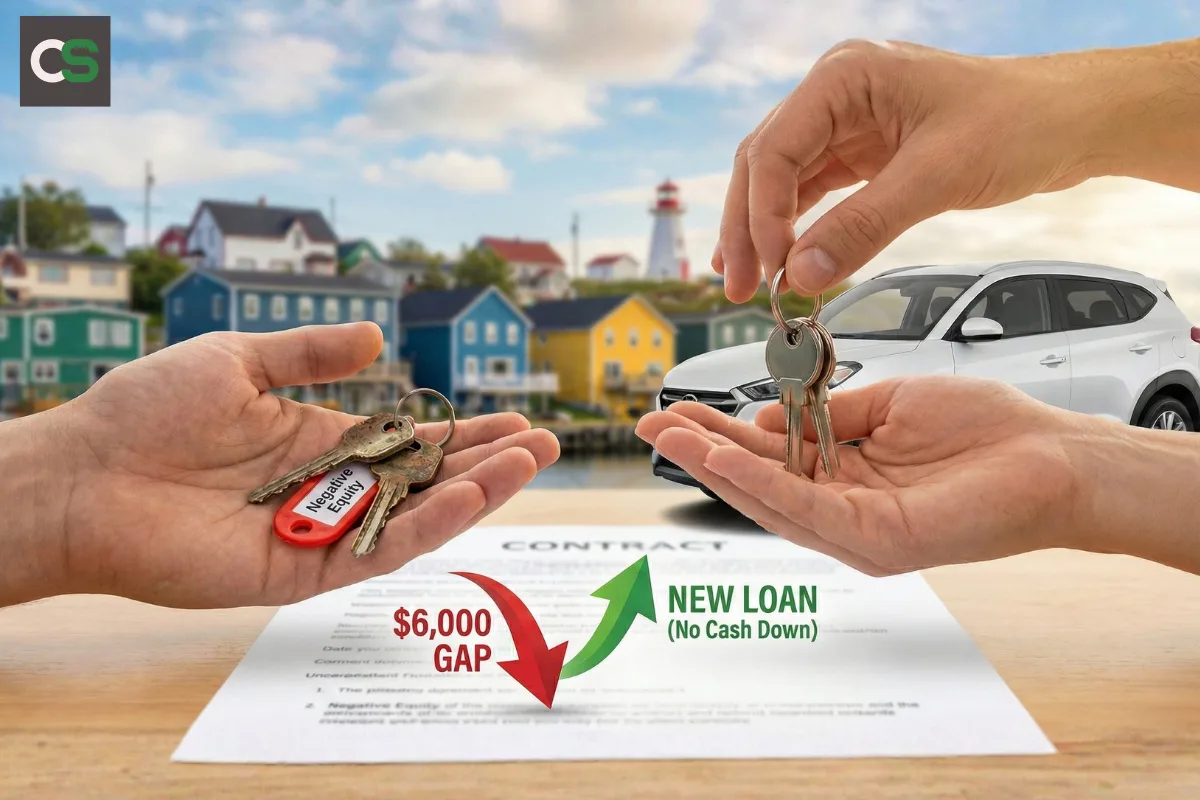
Maybe your family is growing, and that compact sedan no longer fits the car seats. Or perhaps the repair bills for your current SUV are costing more than the monthly payment. But when you check the trade-in value, the math is brutal: You owe $20,000 on a vehicle worth only $14,000.
That $6,000 gap is defined as negative equity.
Trading in a car with negative equity in Atlantic Canada is common, but it requires careful planning to avoid increasing your debt. The good news? You are not trapped.
At CreditShift, we help Atlantic Canadians navigate these tricky waters every day. This guide demonstrates exactly how to execute a negative equity car trade-in by rolling debt into a new loan, utilizing specific loan-to-value (LTV) ratios, and choosing vehicles that balance your financial profile, all without needing a mountain of cash upfront.
What is Negative Equity? (Being “Underwater”)
Before we dive into the “how,” let’s clarify the “what.”
Negative equity occurs when your current auto loan balance is higher than the actual cash value of your vehicle. If you tried to sell your car today, the cash you received wouldn’t be enough to pay off the bank. In the industry, this is often called being “underwater.”
Common Causes of Negative Equity in the Maritimes:
- High Interest Rates: A previous subprime loan where interest accumulated faster than the principal was paid.
- Long Loan Terms: 72 or 84-month terms where the principal balance drops slowly.
- Atlantic Weather Depreciation: In Atlantic Canada, salt and winter conditions can accelerate vehicle depreciation, lowering your trade-in value faster than in other provinces.
- Zero Down Payment: Financing the entire cost (plus taxes and fees) of the original purchase.
When you want to switch vehicles, that leftover debt doesn’t just disappear. It has to go somewhere. This is where the strategy of rolling over debt begins.
The Solution: Rolling Over Debt (How to Trade In Without Cash)
The most common way to handle this situation without paying the difference out of pocket is to roll the negative equity into your next loan.
Dealers who pay off negative equity aren’t technically making the debt vanish; they are restructuring it. The dealership agrees to buy your car for its fair market value, and the “shortfall” (negative equity) is added to the principal of your new loan.
The Math: How a Negative Equity Trade-In Works
| Item | The Calculation |
| New Car Price | $30,000 |
| Trade-In Allowance | $14,000 |
| Existing Loan Payoff | $20,000 |
| Negative Equity (Shortfall) | $6,000 |
| New Loan Total | $36,000 ($30k New Car + $6k Negative Equity) |
By doing this, the dealer pays off your old loan in full. You walk away from the old car and start fresh with a single monthly payment on the new vehicle. It is a seamless transition that keeps you mobile.
The “120% LTV” Secret (How Lenders Approve This)
You might be wondering: “Will a bank really let me borrow $36,000 for a car listed at $30,000?”
The answer lies in the Loan-to-Value Ratio (LTV).
LTV is the percentage of the vehicle’s value that a lender is willing to finance.
- Standard Bank LTV: Often caps at 100% (They lend exactly what the car is worth).
- Specialized Auto Lenders: Often allow LTVs of 120% to 135%.
This extra 20% to 35% is the “magic window” that allows for a negative equity car trade-in. It allows financial experts to “bury” the negative equity into the new loan without requiring you to provide a cash down payment.
Note: Understanding your LTV is the key to getting out of a car loan with negative equity without draining your savings account. At CreditShift, we specifically identify which lenders in our network are currently offering the highest LTV flexibility for your credit profile.
Strategic Vehicle Selection: Best Cars to Hide Negative Equity
Not all cars are created equal when it comes to absorbing old debt.
If you are trying to roll over $5,000 of old debt, you cannot pick a vehicle that depreciates the moment it hits the gravel. To make the math work for the lender, you need a vehicle with a strong Book Value.
1. Heavy-Duty Trucks and Reliable SUVs
In Atlantic Canada, vehicles like the Ford F-150, RAM 1500, or Toyota RAV4 retain their value incredibly well due to high local demand. Because the “Book Value” remains high, lenders are much more comfortable offering high LTV loans on these units.
2. New Vehicles with Rebates
Sometimes it is easier to trade in for a new vehicle than a used one. Why? Because manufacturers often provide “Trunk Money” or Cash Rebates.
- Scenario: You have $5,000 in negative equity.
- Opportunity: The manufacturer offers a $4,000 rebate on a new model.
- Result: That rebate acts like a phantom down payment, effectively wiping out nearly all your negative equity instantly.
Related: If you are buying your first SUV with credit issues, read our guide on SUV Financing With a Thin Credit File to understand approval tiers.
Why GAP Insurance is Critical
When you utilize a negative equity trade-in, you are starting your new loan journey “underwater.”
If you were to have an accident on the Mackay Bridge a month later and the car was totaled, your standard auto insurance would only pay the current “fair market value.” They will not cover the extra $6,000 of debt you rolled over.
This is why GAP Insurance (Guaranteed Asset Protection) is your best friend.
GAP covers the difference between what the insurance company pays and what you still owe the bank. In a negative equity scenario, GAP insurance provides a safety net that prevents a single car accident from becoming a lifelong financial burden.
Trading in a Car You Owe Money On in Halifax: The Risks
We believe in being honest with our Atlantic Canadian neighbors. While trading in a car you owe money on in Halifax or Moncton is a viable strategy, it isn’t always the right move.
You should think twice if:
- The Negative Equity is Massive: If you owe $15,000 more than the car is worth, rolling that into a new loan might make your new monthly payments unaffordable.
- You Are Early in Your Term: If you bought the car six months ago, you haven’t given the loan enough time to mature.
- Your Budget is Tight: Rolling over debt increases your total loan obligation. The goal is to improve your situation (better car, reliability), not just drown in deeper debt.
How CreditShift Helps You Exit Negative Equity
If you feel trapped by your current vehicle, the first step is a professional appraisal that understands the local market.
At CreditShift, we don’t just look at a generic “Black Book” value. We look at the Atlantic Canadian market specifically. Because we work with a massive network of over 100 dealerships, we can often find a home for your trade-in that offers a higher value than a small, local lot, reducing your negative equity gap.
Our Stress-Free Process:
- Apply Online: Get pre-approved without impacting your credit score.
- Get Valuated: Receive a transparent trade-in value based on real Atlantic market data.
- Shift Gears: We show you exactly how much negative equity can be rolled into a newer, reliable ride.
Conclusion
A negative equity car trade-in doesn’t have to be a financial nightmare. By understanding the “rolling over” process, utilizing the 120% LTV rule, and selecting a vehicle that holds its value, you can break the cycle.
You deserve to drive a vehicle that is safe, reliable, and fits your current lifestyle. Don’t let a bad loan from the past stop you from moving forward today.
Are you ready to see your options?
Get pre-approved with CreditShift Today and let our team find the perfect solution for your trade-in. Whether you are in St. John’s, Fredericton, or Charlottetown, we are here to help you shift gears confidently.
Frequently Asked Questions
Can I refinance negative equity without buying a car?
It is very difficult to refinance just the negative equity. Most lenders require the loan to be tied to an asset (a vehicle). If you want to keep your current car but lower the interest, you can look into traditional refinancing, but it won’t remove the negative equity balance.
Does rolling over debt hurt my credit score?
Not directly. If the new loan allows you to make consistent, on-time payments, it helps your credit score over time. However, it does increase your “total debt load,” which is a factor in credit scoring. The key is ensuring the new payment fits comfortably within your budget.
How does CreditShift appraise trade-ins differently?
Unlike many dealers who use a single wholesale price, CreditShift leverages a network of over 100 dealers across Atlantic Canada. This “competitive” environment means we can often secure a higher trade-in value by matching your car with a dealer who specifically needs that exact make and model for their inventory.
Is GAP insurance required for negative equity loans?
While not always required by law, many lenders will make GAP insurance a condition of the loan when the LTV (Loan-to-Value) is high. Even if optional, we strongly recommend it for any negative equity car trade-in to protect you from owing money on a car you no longer drive.
Can I trade in a leased car early?
Yes, you can trade in a lease at any time. The dealer will contact the leasing company for a “buyout quote.” If the buyout quote is higher than the car’s current value, that difference becomes negative equity that can be rolled into a new purchase.