
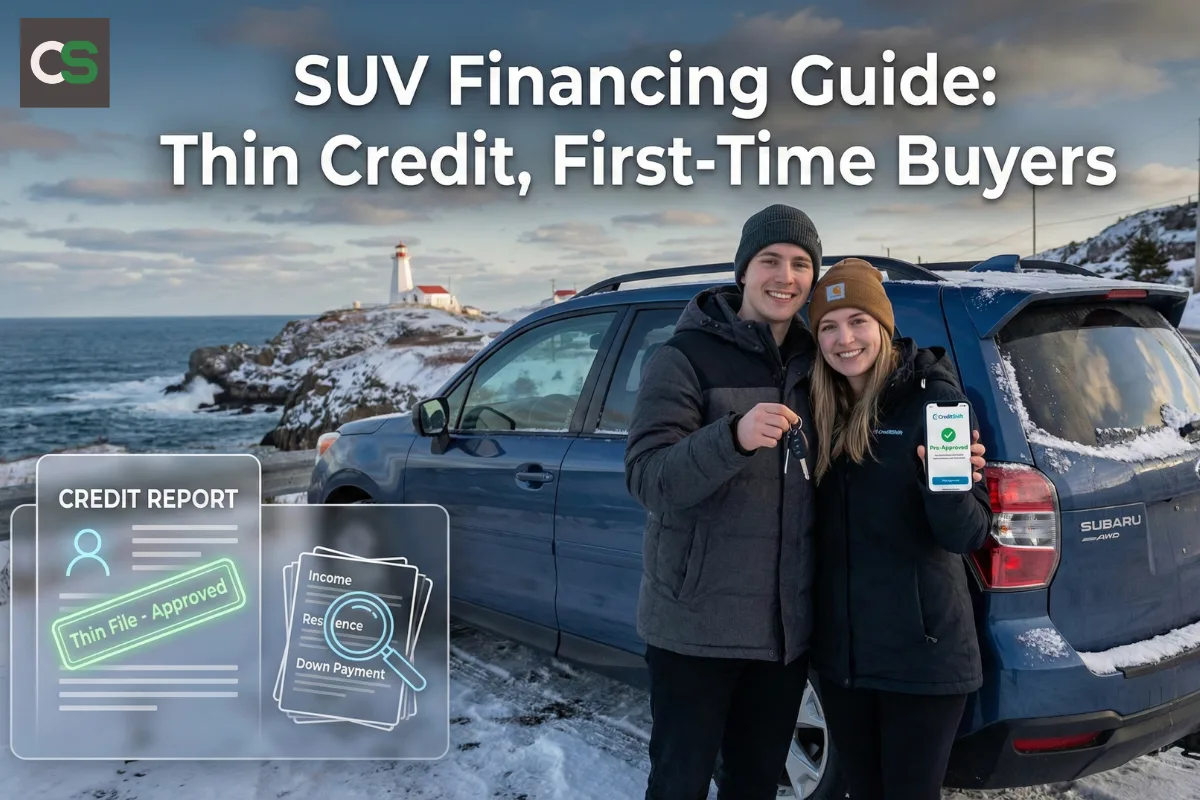
Getting your first SUV is a milestone. It represents freedom, safety, and the ability to tackle the rugged coastlines and snowy highways of Atlantic Canada. But for many first-time buyers, that excitement hits a wall when they hear the term: “Thin Credit File.”
If you have been rejected by a bank or told you have “no score,” do not panic. You are not alone.
In provinces like Nova Scotia, New Brunswick, Prince Edward Island, and Newfoundland & Labrador, thousands of residents – from recent graduates to newcomers to Canada – face this exact challenge. You have the income, you have the discipline, but the credit bureaus just don’t know you yet.
The good news? First-time SUV financing with a thin credit file is entirely possible.
This comprehensive guide will dismantle the myths of “no credit” car loans. We will show you how to leverage your employment stability, calculate the right down payment to lower your Loan-to-Value (LTV) ratio, and secure a reliable, winter-ready SUV through specialized lenders like CreditShift.
1. Diagnosing Your File: “Thin Credit” vs. “Bad Credit”
Before applying, you must understand exactly what lenders see when they pull your Equifax or TransUnion report. These are two fundamentally different financial categories, and they require different approval strategies.
What is a “Thin Credit File”?
A thin file simply means there is insufficient data. You are a financial ghost.
- Who fits this profile? Recent university graduates, newcomers to Canada (within 3-5 years), or individuals who have always used cash/debit.
- The Lender’s View: “We don’t know if they will pay us back.” The risk is Uncertainty.
- Approval Strategy: Prove stability through Alternative Data (income, rent, employment tenure).
What is “Bad Credit”?
Bad credit means there is negative data.
- Who fits this profile? Borrowers with missed payments, collections, consumer proposals, or high credit utilization (>70%).
- The Lender’s View: “They have failed to pay in the past.” The risk is History.
- Approval Strategy: Repair trust through higher interest rates and larger down payments.
Key Takeaway: If you have a thin file, you are actually in a stronger position than someone with bad credit. Specialized lenders in Atlantic Canada view you as a “blank slate” with high potential.
2. The “Atlantic Factor”: Why Your Vehicle Choice Matters to Lenders
In Toronto or Vancouver, an SUV might be a luxury. In Atlantic Canada, lenders understand it is often a necessity. The harsh winters, salt-heavy roads, and rural commutes in areas like Cape Breton or Central Newfoundland require specific vehicle attributes.
Why Lenders Prefer SUVs for First-Time Buyers
Believe it or not, the type of car you buy affects your approval odds.
- Resale Value: AWD SUVs (like a Toyota RAV4, Honda CR-V, or Subaru Forester) hold their value exceptionally well in the Maritimes. This reduces the lender’s risk if they ever have to repossess the asset.
- Safety & Insurance: Modern SUVs have higher safety ratings, which can lower insurance premiums for young drivers compared to sports coupes.
The Cost of “Winterizing” Your Loan
When budgeting for your loan, you must account for the Total Cost of Ownership (TCO) specific to our region. Lenders look at your Debt-to-Income (DTI) ratio, which includes these hidden costs:
| Atlantic Canada Expense | Estimated Cost | Impact on Financing |
| Winter Tires | $800 – $1,200 | Mandatory for safety; some lenders allow you to finance this into the loan. |
| Rust Proofing | $150/year | Critical for resale value due to road salt usage. |
| Insurance | $150 – $250/mo | Higher for first-time drivers. Get a quote before applying. |
| Fuel (AWD) | +10-15% | AWD systems use more gas; factor this into your monthly budget. |
3. How Lenders Assess a “No Credit” Application
Since lenders cannot rely on a credit score (Beacon Score), they switch to Manual Underwriting. They look at the “5 Cs of Credit,” focusing heavily on Capacity and Character.
1. Employment Stability (The #1 Factor)
If you don’t have a credit history, your job is your credit score.
- Gold Standard: 2+ years at the same company.
- Minimum Requirement: Usually 3-6 months past probation.
- Tip: If you are a seasonal worker (common in fishing/tourism industries in Atlantic Canada), bring T4s from the last 2 years to prove your annual income consistency.
2. Payment-to-Income (PTI) Ratio
Lenders want to ensure your car payment doesn’t crush your budget.
- The Rule: Your car payment + insurance should ideally be under 15-18% of your gross monthly income.
- Example: If you earn $3,500/month (gross), your max budget for car + insurance is roughly $600/month. Keeping your request within this limit drastically increases approval odds.
3. Residency Stability
Moving frequently signals risk. Lenders prefer to see you living at the same address for 1+ years.
- Document: Be ready to provide a specialized “Proof of Residency” (Utility bill, internet bill) matching your driver’s license.
4. Structuring Your Deal: The Down Payment Strategy
For thin-credit buyers, the Down Payment is your most powerful tool. It directly impacts the Loan-to-Value (LTV) ratio.
What is Loan-to-Value (LTV)?
Lenders have a cap on how much they will lend compared to the car’s book value.
- Scenario: You want to buy a $20,000 SUV.
- 130% LTV: The lender lends you $26,000 (Car + Taxes + Fees). High Risk. Hard to get with thin credit.
- 100% LTV: The lender lends you $20,000. Medium Risk.
- 80% LTV: You put $4,000 down, lending only $16,000. Low Risk. High Approval Odds.
Recommended Down Payment Targets
- Ideal: 20% (Guarantees best rates).
- Realistic: 10% (Often required by Tier 2 lenders).
- Zero Down: Possible, but requires higher income or a stronger co-signer.
Pro Tip: If you have a trade-in (even a clunker worth $500), it counts as “Cash Down” and lowers your tax liability in most Atlantic provinces, effectively doubling its value to the deal structure.
5. The Application Process: Step-by-Step Guide
Do not shotgun applications to every dealer in Halifax or Moncton. Too many “Hard Inquiries” will hurt your already thin file. Follow this CreditShift blueprint:
Step 1: The “Soft Pull” Pre-Qualification
Start with a Soft Credit Check. This allows lenders (like CreditShift) to see your file without lowering your score. It tells you if you are a “Tier 1” (Bank) or “Tier 3” (Specialty) candidate.
Step 2: Document Gathering (The “Stips”)
Lenders will ask for “Stipulations” to verify your manual underwriting. Have these ready PDF-scanned on your phone:
- Proof of Income: 2 recent pay stubs (must show YTD earnings).
- Bank Statements: Last 3 months (to show no Non-Sufficient Funds/NSF fees).
- Proof of Address: Power bill or Phone bill (dated within 30 days).
- Void Cheque: For pre-authorized debit (PAD) setup.
- References: 2-3 personal contacts (verify they are not living with you).
Step 3: The Co-Signer Option
If your income is borderline, a Co-signer (parent/guardian) with established credit can:
- Lower your interest rate by 5-10%.
- Remove the down payment requirement.
- Help you build credit faster (as the loan reports to both bureaus).
Note: The co-signer is 100% legally responsible for the loan. Make sure they understand this commitment.
6. Interest Rates & Loan Terms: Managing Expectations
First-time buyers often have unrealistic expectations about rates. You will likely not qualify for the 0% or 1.99% advertised on TV – those are for buyers with 750+ scores.
The “Thin Credit” Rate Reality (2025 Estimates)
- Prime (Banks): 7.99% – 9.99% (Requires a Co-signer usually).
- Near-Prime (Credit Unions/Specialty): 10.99% – 14.99%.
- Subprime (No Credit/High Risk): 15.99% – 24.99%.
Do not let the rate scare you.
Think of your first loan as a “Bridge Loan.”
- Strategy: Take the 14% rate today to get the car. Make 12 months of perfect payments. Your credit score will skyrocket. Then, refinance the loan with a bank at 8% next year. You are paying for the opportunity to build credit.
Term Lengths: 48 vs 72 vs 84 Months
- Shorter (48-60 mo): Higher payment, less interest paid, build positive equity faster. Recommended.
- Longer (72-84 mo): Lower payment, but high risk of “Negative Equity” (owing more than the car is worth) in years 3-5. Avoid unless necessary for the budget.
7. New vs. Used vs. CPO: What Should You Buy?
New SUVs
- Pros: Full warranty, latest safety tech, potential for manufacturer “First Time Buyer” rebates.
- Cons: Highest depreciation. It is the hardest to get approved for without a large down payment.
Used SUVs (Private Sale)
- Pros: Cheapest upfront price.
- Cons: Risky mechanical condition. Very difficult to finance with thin credit (lenders hate private sale risk).
Certified Pre-Owned (CPO) – The Sweet Spot
- Pros: These are used vehicles (2-4 years old) inspected by the manufacturer with an extended warranty.
- Why Lenders Love Them: They have taken the big depreciation hit already, but are still reliable. Lenders offer rates very close to “New Car” rates for CPOs.
- Best Picks: Honda Certified, Toyota Certified, Hyundai H-Promise.
8. Dealer vs. Bank vs. CreditShift
| Lender Type | Best For | Pros | Cons |
| Big Banks (TD/RBC) | Strong Co-signer | Lowest Rates | Very strict. High rejection rate for thin files. |
| Dealerships | Convenience | One-stop shop | Limited lenders. Often upsell unnecessary add-ons. |
| CreditShift (Broker) | Thin Credit | Access to 20+ non-prime lenders. “Soft Pull” technology. | Specialized process (not instant bank approval). |
Why CreditShift Wins for Thin Files:
We don’t just send your application to one bank. We treat your profile like a puzzle, matching your specific job stability and down payment with the one lender in our network who specializes in that profile. This minimizes hard inquiries and maximizes approval odds.
9. Common Mistakes to Avoid (The “Deal Killers”)
- Job Hopping: Do not quit your job 2 weeks before applying. Lenders call your employer on the day of funding to verify you are still working there.
- The “NSF” Trap: Lenders look at your bank statements. If they see “Non-Sufficient Funds” (bounced transactions) in the last 90 days, it is an automatic rejection for many. Keep your account clean for 3 months before applying.
- Buying “Too Much Car”: Don’t try to finance a $50,000 SUV on a $40,000 income. It triggers a “High Debt-Service” rejection. Stick to a modest, reliable SUV for your first loan.
10. Conclusion: Your Path to “Prime” Starts Here
Getting approved for SUV financing with a thin credit file in Atlantic Canada is more than just buying a car – it is your first major step into the financial system.
By choosing the right vehicle, preparing your “stips” (documents), and understanding the LTV math, you turn a “No” into a “Yes.”
Remember: This high-interest loan is temporary. The credit history you build is permanent.
Ready to see what you qualify for?
Stop guessing and start driving. [Check Your Approval Odds with CreditShift] today. Our specialized Atlantic Canada team is ready to help you navigate the road to approval – snow, salt, and all.
Frequently Asked Questions (NLP Optimized)
Can I get SUV financing with no credit history in Canada?
Yes. “No credit” (Thin File) is different from “Bad Credit.” Lenders like General Bank, Fairstone, and Santander specialize in “First Time Buyer” programs that focus on your income and job stability rather than your credit score.
How much down payment do I need for a first-time car loan?
While 10-20% is ideal to lower your rate, many lenders offer Zero Down options for thin-credit buyers if you have strong proof of income (typically $2,500+ monthly gross) and long-term employment.
Does a “Soft Pull” hurt my credit score?
No. A “Soft Pull” (or Soft Inquiry) allows lenders to preview your credit report without recording a hit on your file. It does not lower your score. Only a “Hard Pull,” done when you finalize the loan documents, impacts your score (usually by 5-10 points).
What documents do I need for a car loan in Atlantic Canada?
You typically need:
- Valid Driver’s License (Class 5).
- Two recent pay stubs.
- Proof of Address (Utility bill).
- Void Cheque.
- References.
- (Optional) Proof of Enrollment if applying for a “Student/Graduate” program.
Is GAP Insurance worth it for first-time buyers?
Yes. Because you likely have a higher interest rate and a small down payment, you risk having “Negative Equity” (owing more than the car is worth). If you crash your SUV in winter, GAP Insurance covers the difference between what the insurance pays and what you still owe the bank.