
Short Summary:
When you buy a used car through a private sale in Nova Scotia, Access Nova Scotia charges the Nova Scotia Sales Tax (NSST) at 14% on the greater of what you paid or the Canadian Red Book value. The Canadian Red Book is a nationally recognized vehicle valuation database powered by CARFAX Canada. If the Red Book value seems too high, you can hire a licensed appraiser and submit the Motor Vehicle Appraisal Record within two months of purchase to potentially lower your tax bill.
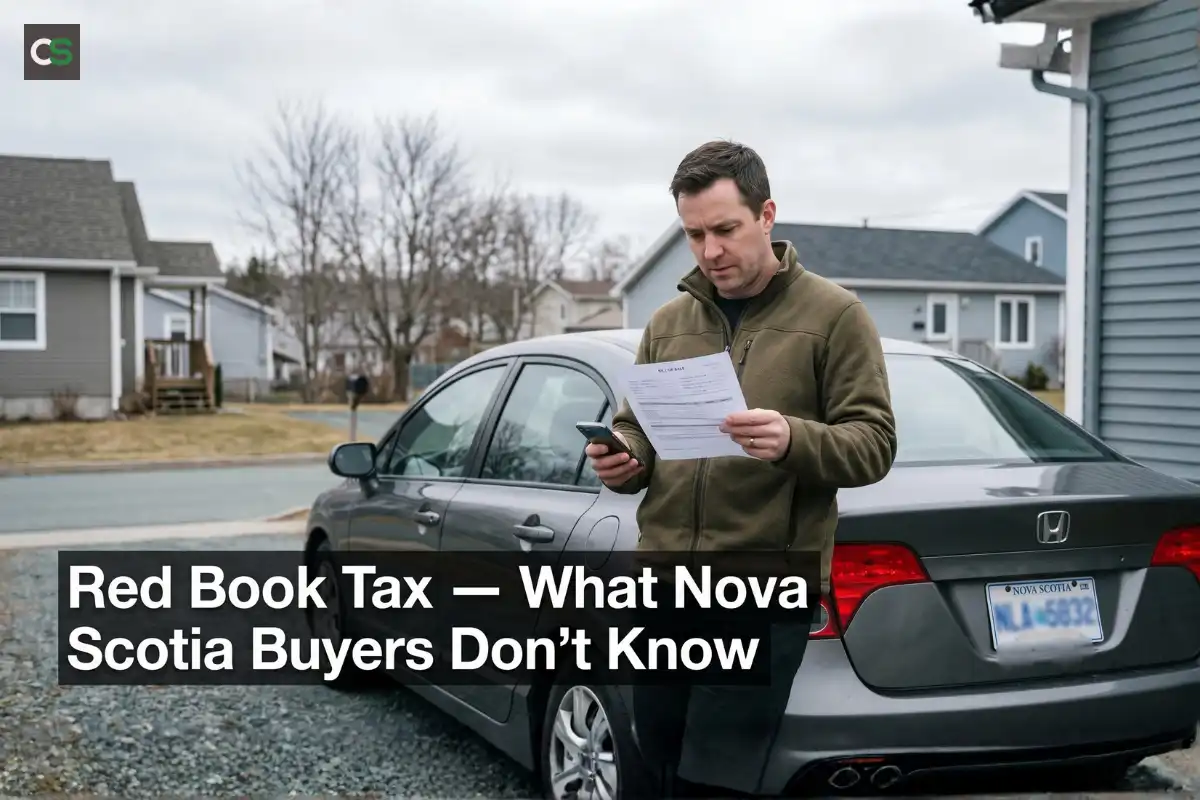
Buying a used car privately in Nova Scotia can feel simple until you get to the Registry of Motor Vehicles and discover you owe tax on a number higher than what you paid.
That number comes from the Canadian Red Book, and it can catch buyers off guard. Understanding how the Red Book value Nova Scotia system works in 2026 is the key to protecting your wallet before you ever sign a bill of sale.
Here we present a complete blueprint that explains exactly how Access Nova Scotia uses the Canadian Red Book, what you can do if the value seems wrong, when you pay zero tax on a family car gift, and why buying through a dealer changes your tax situation entirely.
Whether you are in Halifax, Dartmouth, Sydney, Truro or anywhere across the province, the same rules apply to every private car sale.
What Is the Canadian Red Book and Why Does Nova Scotia Use It?
The Canadian Red Book is a vehicle valuation tool powered by CARFAX Canada and used by governments, insurance companies, financial institutions, and appraisers across the country.
It lists average wholesale values for used vehicles based on make, model, year, trim, and mileage. Nova Scotia, along with New Brunswick and several other provinces, uses it as the official baseline for calculating sales tax on privately sold vehicles.
Because private sellers do not collect HST at the point of sale, Access Nova Scotia steps in during the registration process and applies the NSST to whichever is greater
The government treats the Red Book as a safeguard against underreported sales prices. A free Red Book value check for Atlantic Canada is not publicly available directly on the Canadian Red Book website without a subscription, but your local Access Nova Scotia office can look up the value at the time of registration.
How Access Nova Scotia Uses the Canadian Red Book
Access Nova Scotia applies the Red Book value Nova Scotia rule at the point of vehicle registration for every private sale.
The Registry of Motor Vehicles looks up your vehicle by its VIN number, finds the Canadian Red Book average wholesale value for that specific vehicle, and then compares it to the purchase price on your bill of sale.
Nova Scotia charges NSST on used cars at 14% (down from 15% as of April 1, 2025). That 14% is applied to the sale price or the Red Book figure.
If you paid $10,000 for a car but the Red Book value is $13,500, you pay tax on $13,500. It is how the Access Nova Scotia private sale tax works in practice.
| Scenario | Taxable Amount | NSST Owing (14%) |
| You paid $10,000, Red Book = $10,000 | $10,000 | $1,400 |
| You paid $10,000, Red Book = $13,500 | $13,500 | $1,890 |
| You paid $14,000, Red Book = $13,500 | $14,000 | $1,960 |
| Red Book wholesale = $1,000 or less | Your purchase price only | 14% of the purchase price |
Vehicles with a Red Book wholesale price of $1,000 or under are taxed only on the declared purchase price, with no Red Book comparison applied.
What Happens If You Pay Less Than Red Book Value in Nova Scotia?
It is the scenario that most private buyers find surprising. If you negotiated a deal and paid less than the Canadian Red Book average wholesale value, you still owe NSST on the Red Book figure, not your purchase price.
So if you paid $8,000 for a car that the Red Book values at $11,000, Access Nova Scotia will calculate your tax on $11,000.
A $3,000 difference at 14% adds $420 to your registration bill that you didn’t expect. It is why knowing how Nova Scotia calculates tax on used cars before you finalize a deal is so important.
The Red Book value Nova Scotia system exists to prevent sellers and buyers from artificially reporting low sale prices to reduce tax.
Honest buyers can still be caught out by the Red Book when a car is genuinely worth less than its listed wholesale average due to condition, damage, or high mileage.
Three Steps to Dispute an Inaccurate Red Book Valuation
You are not stuck with a Red Book figure that does not reflect your vehicle’s true condition. The Nova Scotia government gives buyers the legal right to challenge the valuation using a licensed appraiser.
Here is exactly how to do it.
Step 1. Hire a Licensed Vehicle Appraiser
The province requires that your appraisal be completed by either a licensed car dealer or an appraiser registered with the Nova Scotia Provincial Tax Commission.
Unregistered appraisers are not accepted, and the appraisal must be completed within two months of the date you purchased or registered the vehicle.
In Halifax, used-car appraisal services are available at many licensed dealerships. The appraiser will physically inspect the vehicle and assign a fair market value based on condition, mileage, and local market data.
There is no government fee to submit the appraisal form. However, the appraiser may charge a fee for their service.
Even a modest fee can save you hundreds of dollars in NSST if the Red Book figure is significantly higher than your car’s actual condition warrants.
Step 2. Complete the Motor Vehicle Appraisal Record
Your licensed appraiser will complete the official Motor Vehicle Appraisal Record, which is the government form used to challenge the Red Book figure.
The form captures the appraiser’s assessed value and their registration credentials with the Provincial Tax Commission.
The appraised value replaces the Red Book number as your taxable basis, provided the appraisal was completed within the required 2-month window.
Access Nova Scotia will then calculate your purchase price or the appraiser’s value. If the appraiser confirms the vehicle is worth less than the Red Book figure, you pay tax on the lower appraised amount rather than the Red Book wholesale average.
It is the only official method for reducing vehicle sales tax on private purchases in Halifax and across Nova Scotia.
Step 3. Submit the Form Before Transferring Ownership
Bring the completed Motor Vehicle Appraisal Record to your nearest Access Nova Scotia location when you go to register the vehicle.
The form must be presented during the registration process. You cannot submit it after registration is complete and then claim a refund retroactively based on a later appraisal.
Make sure you have your signed bill of sale, the vehicle’s existing registration certificate, and your proof of insurance ready at the same time.
Access Nova Scotia staff will review the appraisal form and apply the correct NSST rate to your transaction on the spot. There is no cost to submit the form itself, and the tax savings are applied immediately at the counter.
How to Find the Red Book Value Before You Register
Many buyers want to know the Canadian Red Book value before they finalize a private deal. The Canadian Red Book, powered by CARFAX Canada, requires a paid subscription for full access.
There is no completely free Red Book value check for Atlantic Canada that gives you the exact number Access Nova Scotia will use. However, several reliable alternatives help you estimate where your vehicle sits:
- Ask a licensed dealer: Any licensed dealership in Nova Scotia can look up the Red Book wholesale value as part of their access to trade publications.
- Use the Access Nova Scotia car tax calculator: The province does not publish an online Red Book lookup, but your local registry office can tell you the figure before you register.
- Request a pre-purchase appraisal: Hire a registered appraiser before you buy to determine the likely tax bill.
Use trade-in value calculators, such as the NS resources available through major Canadian automotive platforms, to get a rough market baseline.
Family Exemptions: Avoiding the Sales Tax Entirely
Nova Scotia provides a full NSST exemption on gifted vehicles transferred between qualifying immediate family members.
It means the recipient pays zero tax at registration, regardless of the Red Book value Nova Scotia assigns to the vehicle.
To qualify for the family gift exemption, both parties must be Nova Scotia residents, and you must submit a Sworn Statement for a Family Gift of a Used Motor Vehicle in the Province of Nova Scotia at the time of registration.
The sworn statement must be witnessed by a lawyer, commissioner, notary public, or a Registry of Motor Vehicles staff member.
Additionally, the vehicle must not have already been transferred tax-free to another immediate family member within the previous 12 months.
Qualifying immediate family members for the exemption include:
- Spouse or common-law partner
- Parent or stepparent
- Child or stepchild
- Sibling
- Grandparent or grandchild
- Former common-law partners transferring a vehicle as part of relationship dissolution (where no written separation agreement exists)
Cousins, aunts, uncles, and friends do not qualify. If you transfer a vehicle to someone outside this list, NSST applies in full based on the Red Book value or purchase price, whichever is greater.
A vehicle received as an inheritance from an estate also qualifies for a separate tax exemption, using the Sworn Statement for the Inheritance of a Used Motor Vehicle in the Province of Nova Scotia form.
Trade-Ins vs. Private Sales: The Tax Advantage of Dealerships
One of the most underappreciated financial advantages of buying through a dealership rather than a private seller is how sales tax is applied.
When you buy a used vehicle from a licensed dealership in Nova Scotia, the dealer collects HST on the transaction price, and critically, the Red Book value comparison does not apply. You pay HST only on what you actually pay the dealer.
Furthermore, if you trade in a vehicle at a dealership, the trade-in value is deducted from the purchase price of your new vehicle before HST is calculated.
It can deliver significant savings. Here is what that looks like in real numbers:
| Private Sale Scenario | Dealership Trade-In Scenario |
| Buy a $20,000 used car privately | Buy a $20,000 used car at a dealer, trade it in worth $5,000 |
| Red Book may value it at $22,000 | Taxable amount = $20,000 minus $5,000 = $15,000 |
| NSST = 14% of $22,000 = $3,080 | HST = 14% of $15,000 = $2,100 |
| No trade-in credit possible | You save $980 in tax versus the private scenario above |
It is one of the key reasons why working with a dealership or a financing broker can make more financial sense than buying privately, especially when your vehicle has meaningful trade-in value.
Learn a detailed comparison of how auto dealerships and financing companies differ in Atlantic Canada and see which approach puts more money back in your pocket.
Common Mistakes Nova Scotia Buyers Make With the Red Book Tax
Thousands of Nova Scotia buyers walk into Access Nova Scotia unprepared each year. Here are the most common and costly errors to avoid:
- Not budgeting for the Red Book difference: Budget for NSST on the Red Book value, not just what you agreed to pay the seller.
- Missing the two-month appraisal window: If you believe the Red Book overvalues your vehicle, act immediately. Waiting too long forfeits your right to challenge it.
- Using an unregistered appraiser: Only dealers or appraisers registered with the Provincial Tax Commission are accepted. A friend’s opinion or an online estimate will not be accepted by Access Nova Scotia.
- Assuming a family transfer is automatically tax-free: You still need to submit the sworn statement and meet all conditions. Simply being related is not enough.
- Forgetting about the Red Book when the car has damage: If your private purchase has body damage, rust, or mechanical issues, a registered appraisal might bring the taxable value well below the Red Book figure and save you real money.
Professional Valuation Standards: Why the RMV Trusts the Red Book
The Canadian Red Book is the gold standard for vehicle values because it uses actual transaction data from across Atlantic Canada.
Unlike free online estimators that guess a price based on asking prices, the Red Book tracks what cars actually sell for at wholesale auctions.
It is why Access Nova Scotia uses it as its primary tool for tax collection. It creates a fair playing field for everyone in Halifax and Sydney.
Experience with High Mileage and Mechanical Defects
If you buy a car with a blown engine or 400,000 kilometres on it, the standard Red Book wholesale value will be too high.
A standard clerk at the Registry of Motor Vehicles cannot change the number on their screen just because you show them a photo of a dent.
It is where professional expertise matters. A licensed appraiser examines the specific mechanical failures that the Red Book software cannot detect.
Calculating the True Cost of Ownership: Tax vs Interest
Many buyers focus so hard on the purchase price that they forget about the hidden costs of a private sale.
When you buy privately, you must pay the 14 percent NSST upfront in cash at the registry office. If you do not have 3,000 dollars in your bank account for taxes and registration, a private deal can fall apart.
Financial Strategy: Rolling Tax into a Managed Loan
At CreditShift, we help you avoid the stress of a massive upfront tax bill. Because we work with a network of licensed dealers, the 14 percent tax is included in your total financing package.
It means you do not have to drain your savings at the Access Nova Scotia counter. You get a fully inspected vehicle, and the tax is handled transparently as part of your monthly payment.
Comparing Appraiser Credentials: Who Can Legally Help You?
Not everyone with a mechanic shop can sign a Motor Vehicle Appraisal Record. To build trust with the Provincial Tax Commission, the person must be a registered appraiser or a licensed dealer.
Using an unauthorized person will result in your claim being rejected. Always check your appraiser’s registration number before you pay them for a valuation.
Red Book Exemptions for Unique Vehicles
There are specific cases where the Red Book does not apply. This includes very old classic cars or custom-built vehicles that do not appear in the standard database.
In these cases, the government relies entirely on a professional appraisal. If you are buying a unique vehicle in Nova Scotia, getting an appraisal before you visit the registry is the only way to ensure a smooth registration process.
Expert Tips on The 60 Day Deadline for Tax Refunds
If you already paid the high tax at the registry but believe the car was worth less, you have a small window to fix it.
You have 60 days from the date of registration to submit a professional appraisal and request a refund for the overpaid tax.
It is a crucial safety net for Nova Scotia buyers who were caught off guard by the Red Book value at the counter.
Why CreditShift Prioritizes All-In Transparency
We believe that no one should ever be surprised by a tax bill. Our team calculates the exact provincial tax before you sign any documents.
We compare the dealer price against regional data to ensure you are getting a fair deal. By choosing a managed financing path, you gain the protection of a professional team that understands the Nova Scotia Motor Vehicle Act inside and out.
The Bottom Line on Red Book Value Nova Scotia in 2026
The Red Book value Nova Scotia system exists to ensure everyone pays their fair share of sales tax on used vehicle transactions.
As a buyer in a private sale, the most important things you can do are: know the Red Book value before you commit to a deal, budget for tax on the higher of the two numbers, act quickly if you want to dispute the value with a licensed appraisal, and understand that family gifts and dealership trade-ins come with significant tax advantages.
Whether you are shopping for a truck in Truro, a sedan in Sydney, or an SUV in Halifax, the Canadian Red Book value will determine a significant portion of your total ownership cost.
Going in with the right information means no surprises at the Access Nova Scotia counter and more money staying in your pocket where it belongs.
Frequently Asked Questions on Red Book Value Nova Scotia in 2026
Do I pay tax on the purchase price or the Red Book value?
You pay Nova Scotia Sales Tax on whichever is greater: your purchase price or the Canadian Red Book wholesale value.
How do I dispute a high Red Book value in Nova Scotia?
Hire a registered appraiser within two months, complete the Motor Vehicle Appraisal Record, and submit it at Access Nova Scotia during registration.
Do family members pay sales tax on gifted cars?
No. Immediate family members in Nova Scotia pay zero NSST on gifted vehicles when a sworn statement is submitted at registration.
Where do I find the Canadian Red Book value for free?
Ask any licensed Nova Scotia dealer or visit an Access Nova Scotia office. The website itself requires a paid subscription for full access.
Does a private seller charge sales tax in Nova Scotia?
No. The private seller does not collect tax. The buyer pays NSST directly to Access Nova Scotia at the time of vehicle registration.
Can I get a refund if I overpaid NSST on a private vehicle purchase?
Yes. If you believe NSST was collected in error, you can apply for a refund through the Nova Scotia Sales Tax program at Access Nova Scotia.
What is the NSST rate on used cars in Nova Scotia in 2026?
The current NSST rate is 14%, reduced from 15% as of April 1, 2025, matching the provincial HST rate reduction.
Does the Red Book value apply to motorcycles and ATVs?
Motorcycles and off-road vehicles use the Canadian Sport Vehicle Blue Book rather than the Red Book in Atlantic Canada.