

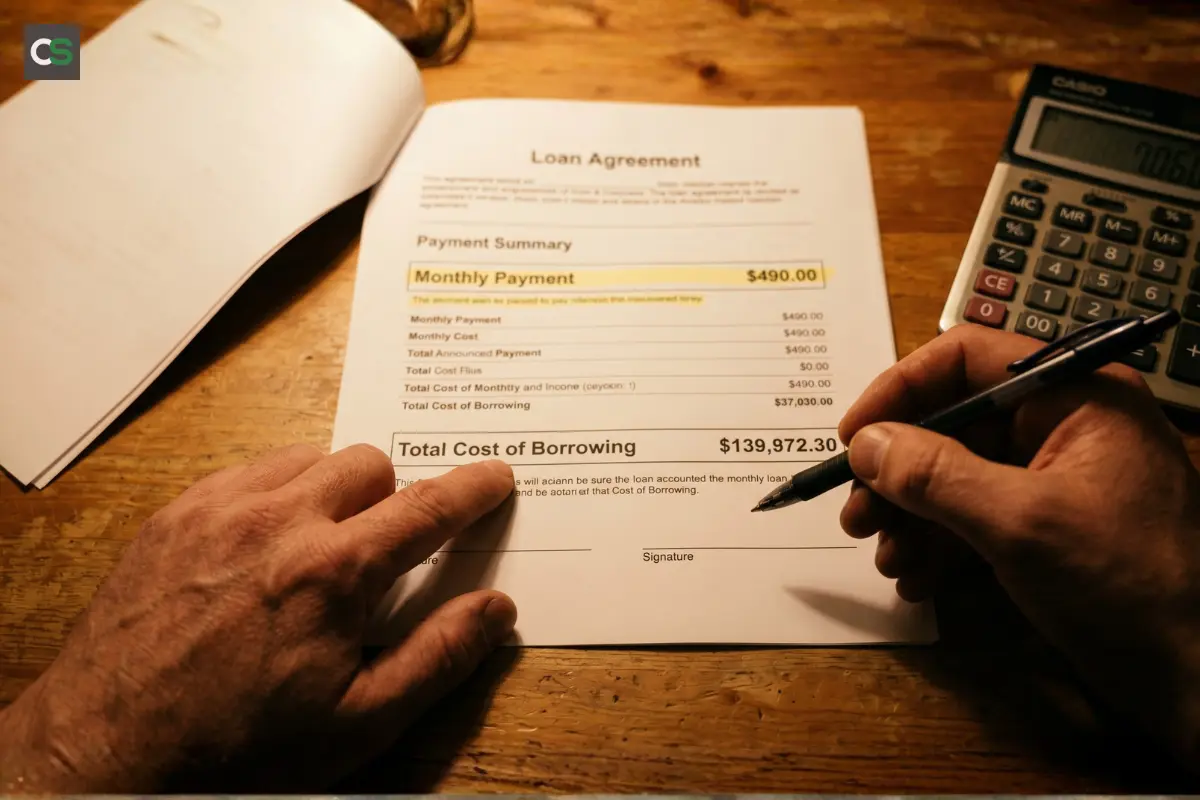
An 84-month car loan stretches your payments over seven years. For most Canadians, financing a used vehicle is a costly mistake. We have helped thousands of Atlantic Canadians navigate auto financing, and the pattern is mostly same: the borrowers who regret their loan almost always picked the longest term available.
They saved $100 a month on paper and paid $5,000 more over the life of the loan. You pay more interest and likely owe more than the car is worth within a few years. And in Atlantic Canada, Maritime winters often destroy the vehicle before you finish paying for it. Before you sign anything, get the full picture. An auto financing company in Atlantic Canada runs these numbers across multiple lenders before a deal gets put in front of you. Here’s what you need to know.
What Canada’s Tax Rules Actually Mean for 84-Month Borrowers
Auto loan interest is not tax-deductible for personal vehicle use in Canada. That means every extra dollar you pay in interest on a long-term loan comes straight out of your take-home pay, no relief from the CRA (Canada Revenue Agency). If you’re self-employed and use the vehicle for business, CRA does allow a proportional deduction based on business-use percentage.
But that deduction is capped, and the eligible capital cost limit means interest on loans above that threshold gets you nothing extra. You also need meticulous records to claim it. For the vast majority of Atlantic Canadians driving to work each day, the interest cost on a 7-year loan is a pure expense.
Is an 84-Month Car Loan a Bad Idea for Most Canadians?
Yes, an 84-month car loan is generally a bad idea for used vehicles because the interest costs typically exceed $5,000 extra compared to a 60-month term. In Atlantic Canada, the vehicle often depreciates or suffers structural salt damage before the 7-year principal is paid off, leading to severe negative equity. Stretching a $30,000 loan over seven years drops your monthly payment. But the hidden cost is steep.
A 2025 analysis found that financing a $40,000 vehicle over 84 months versus 60 months costs over $3,000 more in interest alone, before accounting for the higher rates lenders charge on longer terms.
The numbers back this up. Edmunds data shows 84-month loans made up a record 19.8% of new-vehicle financing in Q1 2025. By Q1 2026, 43% of underwater trade-in customers had 84-month terms, the highest share since 2021. Nearly half of everyone trading in a car they couldn’t break even on got there through a 7-year loan.
The risks stack up fast:
- Negative equity from day one – Cars depreciate fastest in the first three years; principal paydown is too slow to keep up
- Higher interest rates – Lenders charge more for longer terms because default risk rises over time
- No flexibility – You can’t trade in, sell, or refinance easily when you’re deeply underwater
- Outlasted warranty – Most manufacturer warranties expire at 3–5 years or 60,000–100,000 km, well before your loan ends
One financial expert put it plainly: “If you can’t pay off your loan in 3 to 5 years, you probably can’t afford it.”
Can You Even Get an 84-Month Loan on a Used Car in Canada?
Technically, yes – but lender rules make it extremely difficult, and often impossible, for older used vehicles. Canadian lenders impose strict vehicle age limits that directly conflict with 84-month terms. Here’s how the restrictions typically break down:
| Vehicle Age | Maximum Loan Term (Typical) | Lender Type |
| 0-4 years old | Up to 84 months | Banks, credit unions, dealer lenders |
| 4-6 years old | Up to 60-72 months | Credit unions, some dealer lenders |
| 6-10 years old | 36-48 months | Select lenders only |
| 10+ years old | Usually refused | Banks rarely finance; some credit unions offer up to 15 years |
Toronto-Dominion Bank (TD) only finances vehicles that are five years old or newer. For an 84-month term specifically, most lenders, including Canada Drives, confirm the vehicle needs to be four years old or less. Once a car hits six years old, lenders typically cap the loan at 60 months maximum.
The reasoning is simple: lenders won’t hold a loan on a car that may break down or lose all resale value before the debt is cleared.
This creates a real paradox for used car buyers: the vehicles most likely to need long-term financing are exactly the ones lenders are least willing to extend terms on.
Good to Know: Even if you qualify for an 84-month loan on a used car, qualifying doesn’t mean it’s the right call. The lender gets paid either way; you’re the one carrying the risk.
Why Maritime Winters Make 7-Year Car Loans Even Riskier
Atlantic Canada has some of the heaviest use of road salt in Canada. That salt stays liquid in freezing temperatures and seeps into every seam, weld point, and wheel well on your vehicle. Surface rust shows up within 2 to 3 years. By years 5 to 7, you can be looking at bubbling paint, pitted metal, and structural damage to frames and suspension mounts.
Now put that timeline against an 84-month loan. By year five or six, you may be dealing with undercarriage corrosion that affects how safe the car is to drive, repair bills that cost more than the car is worth, and rust-related mechanical failures that no warranty will cover.
Depreciation makes it worse. Cars lose roughly 15 to 25% of their value in year one and keep dropping. A $25,000 used car in Nova Scotia could be worth under $10,000 by year seven. Meanwhile, your loan balance drops much more slowly than the car’s value. That gap is called negative equity, and it grows every year you hold a long-term loan on a depreciating vehicle in a salt-heavy climate.
By year four or five, a mechanic may tell you the car isn’t worth fixing. But your loan says you still owe thousands. You can’t sell it, trade it in, or walk away without absorbing that loss out of pocket. A shorter loan term is the simplest protection against this. The faster you pay down the principal, the less time the Maritime winter has to put you in that position.
Heads Up: Wondering how to handle a situation where you’re already upside down? CreditShift has a full breakdown on how to trade in a car with negative equity in Atlantic Canada.
How Much Extra Does an 84-Month Car Loan Actually Cost You?
The monthly payment illusion is the 84-month loan’s most dangerous feature. Here’s an honest breakdown using a $30,000 used vehicle at realistic Canadian rates:
| 60-Month Loan | 84-Month Loan | |
| Loan Amount | $30,000 | $30,000 |
| Interest Rate | 7.50% | 9.5%* |
| Monthly Payment | $601.14 | $490.32 |
| Total Paid | $36,068.31 | $41,186.83 |
| Total Interest Paid | $6,068.31 | $11,186.83 |
| Extra Interest vs. 60-mo | — | #ERROR! |
84-month rates are typically 1.5–2.5% higher than 60-month rates because lenders charge a premium for extended-term risk. The apparent “savings” of choosing 84 months over 60 months is just $110.82 per month.
But it costs you an extra $5,118.52 over the life of the loan. You pay more than five thousand dollars for the privilege of a slightly lower monthly payment, and you do it across 24 extra months of payments.
The math behind this is the standard loan amortization formula:
PMT = PV · i(1+i)ⁿ / (1+i)ⁿ − 1
Where PV is principal, i is the monthly interest rate, and n is the number of months. A longer n lowers your monthly PMT, but dramatically increases total interest because every extra payment period adds another month of interest accruing on the remaining balance.
Pro Tip: The average interest rate on an 84-month car loan is meaningfully higher than shorter terms, often 1.5–2.5 percentage points more.
Before you focus on the monthly payment, ask the lender for the total cost of the loan. That’s the real number.
Smarter Ways to Finance a Used Car Without a 7-Year Trap
CreditShift works with Atlantic Canadians every day who feel like a long loan term is their only option. It rarely is. Here are the strategies that actually work:
1. Choose a less expensive vehicle
If a 60-month payment on your target vehicle feels unaffordable, the vehicle is outside your budget, not your loan term. Right-sizing the purchase (choosing a less expensive vehicle) solves the problem cleanly.
2. Save a larger down payment first
A 15–20% down payment immediately shrinks your principal, lowers your monthly payment, and cuts your total interest without extending your term. Delaying a purchase by 3–4 months to save more can be worth thousands.
3. Go for a 48- or 60-month term
This is the sweet spot. You build positive equity faster, stay covered by warranty longer, and keep the flexibility to trade in or refinance without being underwater.
4. Work on your credit before applying
A stronger credit score unlocks lower interest rates. The gap between 7.5% and 9.5% — as shown above — is worth more than $5,000 over the loan. CreditShift specialises in helping Canadians with non-prime credit access fair-rate financing and build a path to better terms over time.
5. Refinance if you’re already in an 84-month loan
If you’re locked into a long-term loan right now, refinancing to a shorter term when your credit improves can cut your total interest significantly. Learn more about how auto loan refinancing works in Atlantic Canada to see if it makes sense for your situation.
6. Don’t roll negative equity into a new loan
One of the most common traps we see is borrowers trading in an underwater vehicle and rolling thousands in negative equity into a new loan, compounding the problem.
If you’re upside down, pay down the gap before trading, or hold the vehicle until you’ve built real equity.
Best Practice: If a lender is leading with the monthly payment and not the total cost of the loan, that’s a red flag. Always ask: “What do I pay in total, start to finish?”
The Real Verdict on 84-Month Car Loans in Atlantic Canada
An 84-month car loan is almost never the right answer for a used vehicle in Canada. In Atlantic Canada, Maritime winters speed up rust and depreciation, so the risk is even greater.
Yes, the monthly payment is lower. But you’ll pay $5,000+ more in interest over the life of the loan, and you’ll likely owe more than the car is worth for most of those seven years. The vehicle may need major repairs or be undrivable before you’ve made your last payment.
The smarter move is a shorter term, a right-sized vehicle, or a stronger credit profile before you apply. That’s the kind of financing that builds your future instead of draining it.
Questions We Hear All the Time About Car Financing
What should you not do when financing a car?
Don’t chase a low monthly payment; it usually means a longer term, more interest, and a loan that costs you thousands more by the end.
Is financing a car ever worth it?
Yes, financing a car is worth it when the term is short, the rate is fair, and the payment fits your real budget.
What is a good interest rate on a car loan in Canada?
For borrowers with strong credit, rates in Canada typically run between 6% and 9% right now. If your score is lower, you’ll pay more, but not forever.
Can you pay off an 84-month car loan early without a penalty?
Most Canadian auto loans have no prepayment penalties, but confirm with your lender first, then pay it down as fast as you can in the early years when interest hits hardest.
What happens if my financed car breaks down permanently, but I still owe money?
You still owe every dollar remaining on the loan, and if insurance pays out less than what you owe, that gap comes out of your pocket.