
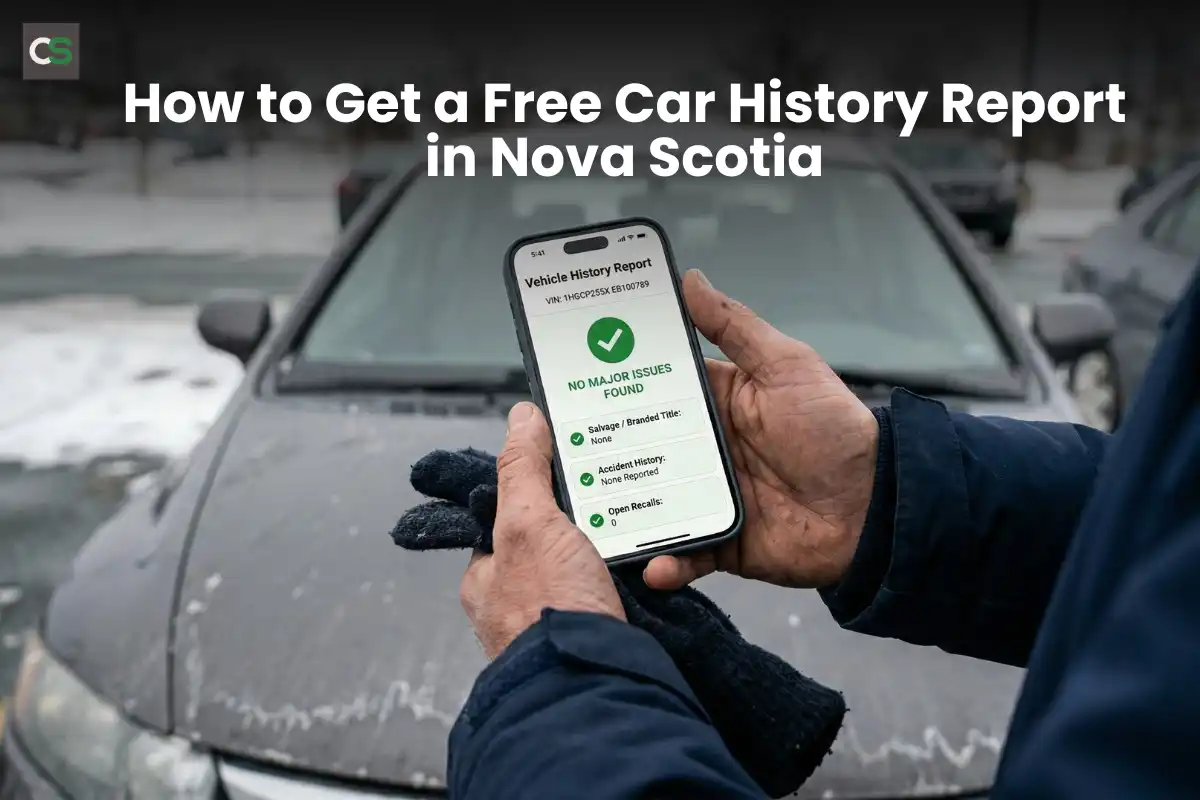
The Insurance Bureau of Canada VIN Verify tool provides a free car history report in Nova Scotia. This database identifies non-repairable, flood-damaged, or salvaged vehicles. The Transport Canada recall database locates open safety notices using the vehicle identification number. Both government systems operate at zero cost. Paid Carfax Canada reports reveal full accident histories, lien status, and ownership transfers. Free checks establish a necessary baseline. Buyers must pair any VIN search with a physical inspection before purchasing a used vehicle.
How to Run a Free VIN Check in Nova Scotia
Your vehicle’s VIN is a 17-character code stamped on the dashboard, near the driver’s side windshield. It is also on your registration documents. You can use it to run a free car history report in Nova Scotia through two government-backed tools right now, at no cost.
Step 1: The Insurance Bureau of Canada (IBC) VIN Verify Tool
The IBC VIN Verify tool is the most important free check available to buyers in Atlantic Canada. It is run by the Insurance Bureau of Canada, which is the national industry association for Canada’s private home, auto, and business insurers.
-
- What it checks: The IBC database flags vehicles that have been branded as Non-Repairable, Salvage, Flood-damaged, or Fire-damaged by a participating member insurance company. It covers Alberta, Ontario, and all Atlantic Provinces, including Nova Scotia.
- What Non-Repairable means: A non-repairable vehicle can never legally be registered and driven on any Canadian road again. It was so severely damaged by collision, fire, or flood that no amount of repair can make it roadworthy. Fraudsters buy these vehicles cheaply and attempt to sell them as drivable cars. The IBC tool stops that.
- What it checks: The IBC database flags vehicles that have been branded as Non-Repairable, Salvage, Flood-damaged, or Fire-damaged by a participating member insurance company. It covers Alberta, Ontario, and all Atlantic Provinces, including Nova Scotia.
How to use it:
- Visit the official IBC website and accept the terms of use.
- Enter the 17-digit VIN to verify the vehicle status in the non-repairable database.
- The system returns instant results. The IBC tool displays only the vehicles reported by member insurers. Out-of-pocket repairs remain hidden.
Step 2: Transport Canada Recall Database
The Transport Canada recall database is a free government tool that shows whether a vehicle has been recalled by its manufacturer due to a safety defect.
It is completely separate from accident history. A recall means the manufacturer itself identified a problem and issued a repair notice.
Why This Matters In Nova Scotia
Atlantic winters are hard on vehicles. Some of the most common recalls involve brake systems, rust on structural components, and electrical issues from moisture exposure. Buying a vehicle with an open recall means you are buying one that the manufacturer has flagged as unsafe in its current state.
How To Use It
- Search the Transport Canada website for “vehicle recalls”.
- Enter the 17-digit VIN to review open safety notices, or search by year, make, and model.
- Confirm repair completion with the seller.
Authorized dealerships fix open recalls for free. Buyers hold leverage to demand these repairs before signing any purchase agreement.
Free VIN Checks vs. Paid Carfax Reports: Understanding the Difference
A free VIN check, Halifax buyers commonly run through IBC or Transport Canada, is a starting point, not a finishing line. Here is an honest look at what each option gives you.
| Feature | IBC VIN Verify (Free) | Transport Canada (Free) | Carfax Canada (Paid) |
| Cost | $0 | $0 | $50.95 to $69.95 |
| Non-repairable / Salvage brands | Yes | No | Yes |
| Open safety recalls | No | Yes | Yes |
| Accident history | No | No | Yes (if reported) |
| Lien/loan check | No | No | Yes (add-on) |
| Ownership transfers | No | No | Yes |
| US history | No | No | Yes |
| Odometer records | No | No | Yes |
| Covers Atlantic Canada | Yes | Yes | Yes |
A good Carfax alternative for Canadian buyers is VinAudit Canada, which offers reports for $14.95 per vehicle.
VinAudit covers registration records, recall records, theft records, and manufacturer buyback history. It is a budget-friendly middle ground between a free check and a full Carfax report.
Paid reports are only as good as what they’re given to report. An accident that was never reported to insurance or a private repair done without documentation will not appear on any report, free or paid. That is why physical inspections still matter.
Access Nova Scotia Registry Rules for Branded and Rebuilt Titles
When a vehicle is severely damaged in Nova Scotia, the Registry of Motor Vehicles (RMV) assigns a brand to its title.
This brand travels with the vehicle permanently. Understanding these brands is critical to checking if a car has been in an accident for free in Nova Scotia using official records.
Nova Scotia uses the following title brands under the Motor Vehicle Act:
| Brand | What It Means | Can It Be Driven? |
| Salvage | Insurance declared it a total loss | No, until repaired and inspected |
| Rebuilt | Was salvage, now repaired and passed provincial inspection | Yes, but history must be disclosed |
| Non-Repairable | Damage so severe that it can never be roadworthy again | Never illegal to register |
| Normal | No branded status on record | Yes |
How To Spot A Rebuilt Title In NS?
Service Nova Scotia and the RMV manage the provincial vehicle registry. Contact Access Nova Scotia directly to confirm the title brand status. The official registration certificate displays this brand. Sellers must disclose rebuilt titles. Insurers hesitate to cover these vehicles; lenders refuse to finance them.
Criminals move cars between provinces to erase branded histories. A non-repairable vehicle from New Brunswick often enters Nova Scotia for re-registration with altered documentation. The IBC prevents this fraud by tracking the permanent VIN.
The Reporting Lag: Why Clean Reports Hide Recent Halifax Accidents
It is one of the most overlooked facts about vehicle history reports, and it is especially relevant for buyers doing a free car history report in Nova Scotia.
Even Carfax is not real-time.
What Happens After A Car Accident In Halifax?
- The driver contacts their insurer, usually within 24 to 72 hours, for a standard claim.
- The insurer investigates and adjudicates the claim, which can take days to weeks for complex collisions.
- Once settled, the insurer reports the claim data to providers like Carfax Canada and the IBC database.
- Carfax and IBC update their records, but there is no mandated real-time transfer.
- Some accidents involving minor damage are repaired out of pocket and never reported.
The result?
A vehicle involved in a collision on Robie Street in Halifax last month could still show a clean report today. It may not have been processed and reported yet.
Additionally, private sellers sometimes pay for bodywork or mechanical repairs without filing a claim.
Cash repairs leave no paper trail on any history report, free or paid. According to Canada Drives, it is one of the most common reasons a vehicle history report should never be your only due diligence step.
The Nova Scotia Motor Vehicle Act also requires a Motor Vehicle Inspection (MVI) for most used car private sales, no more than 30 days before the sale.
Always ask for the MVI number.
If the seller cannot provide one, that is a warning sign.
Pre-Purchase Inspections: The Ultimate Alternative to Paper Reports
No report, free or paid, can replace a mechanic putting the vehicle on a lift. A qualified technician can spot fresh welds on a repaired frame, mismatched panel gaps from a collision repair, signs of underbody corrosion from Nova Scotia’s notorious road salt, or water staining inside the engine bay from flood exposure.
What a pre-purchase inspection covers:
- Frame and structural integrity check, looking for signs of prior collision repair.
- Underbody rust and corrosion inspection is critical in Nova Scotia’s salt-heavy winters.
- Engine and transmission health, including oil condition and fluid leaks.
- Brake system inspection, pads, rotors, lines, and callipers.
- Electrical system check, especially important for used hybrids and vehicles that have been exposed to moisture.
- Suspension and steering components, worn parts common on Halifax’s potholed roads.
- Tire condition and alignment check.
Independent mechanics in Halifax charge between $100 and $200 for a standard pre-purchase inspection. CAA-approved centres in Dartmouth and Bedford offer similar diagnostic services. A seller refusing an independent inspection signals severe mechanical issues.
Sellers who refuse to allow a pre-purchase inspection are a red flag. A seller with nothing to hide will always say yes.
Why CreditShift Dealers Provide Free 150-Point Inspections and Carfax Reports
One of the most common questions from used-car buyers in Halifax is whether Halifax dealerships offer free Carfax reports.
The answer depends entirely on who you buy from.
At CreditShift, every vehicle in our Atlantic Canada dealer network of 100+ independent dealers comes with a Carfax Canada report included. You do not need to pay $50.95 to find out what you are buying. You get full transparency before you commit.
What Creditshift Vehicles Include As Standard?
- Full Carfax Canada Vehicle History Report: Accident history, ownership transfers, lien status, recall records, and Canadian and US history.
- 150-Point Vehicle Inspection: A comprehensive mechanical and safety check is completed before any vehicle enters our network inventory.
- Warranty Coverage: Optional warranty and walk-away insurance for additional peace of mind
- Nova Scotia MVI Compliance: All vehicles meet Motor Vehicle Inspection requirements, no surprises at registration.
- Home Delivery Across Atlantic Canada: We deliver directly to your door in Halifax, Dartmouth, Moncton, Charlottetown, or St. John’s
Do Halifax Sackville Drive dealerships provide free Carfax reports? Some do, some do not.
Always ask before you agree to anything. If a dealership hesitates or charges you separately for a history report that they should absorb as a cost of doing business, that tells you something about how they operate.
The entire CreditShift model was built to take the guesswork and the risk out of buying a used vehicle in Atlantic Canada.
Whether your credit is excellent or you are rebuilding from scratch, you deserve full information about any vehicle you are asked to finance.
Conclusion
A free car history report in Nova Scotia is one of the smartest things you can do before buying a used vehicle.
The IBC VIN Verify tool and Transport Canada recall database cost you nothing and can save you from buying a vehicle that is legally undrivable or has a dangerous open safety defect.
But free tools have limits. They cannot show you accident history, liens, or recent damage that has not yet been reported.
A paid Carfax or VinAudit report fills in much of that gap. And a physical pre-purchase inspection, done by a trusted mechanic in Halifax or your nearest town, fills in the rest.
The safest and easiest path for most Nova Scotians is to buy through a network like CreditShift, where every vehicle comes with a Carfax report and a 150-point inspection included, at no extra cost and with no assumptions.
And if financing is a concern because your credit is not perfect right now, that does not have to stop you.
To understand exactly what lenders look at and what score you actually need, take a look at the credit score you actually require for a car loan in Canada.
It answers the question more honestly than most handbooks do.
Ready to find a verified, inspected used vehicle in Nova Scotia?
Apply now or call 902-700-6902 for a free two-minute pre-approval.
Frequently Asked Questions on How to Get a Free Car History Report in Nova Scotia in 2026
Does Access Nova Scotia provide free vehicle history reports?
No. Access Nova Scotia confirms title brands only. For a full accident and lien history, use paid Carfax Canada or VinAudit.
How do I check for a rebuilt title in Nova Scotia?
Use IBC VIN Verify, contact Access Nova Scotia directly, or order a paid Carfax Canada report to confirm any branded history.
Are free VIN checks accurate for Canadian used cars?
The government databases provide accurate data with strict limits. Free searches identify salvage brands and safety recalls. They miss minor accident records, financial liens, and unreported physical damage.
Do Sackville Drive dealerships provide free Carfax reports?
Some do, some do not. Always ask first. CreditShift includes Carfax reports on every vehicle in its dealer network.
How long does the IBC take to report an accident?
No fixed timeline. It typically takes a few weeks to several months after a claim is settled and submitted.
Can I check a VIN from a license plate in NS?
Yes, but privacy rules apply. Ask the seller directly for the VIN, then run it free through IBC and Transport Canada.
What is the difference between a salvage and a rebuilt title?
Salvage means total loss, not road-legal yet. Rebuilt means repaired, inspected, and re-registered. Both must be disclosed by sellers.
What happens if I buy a title-washed car in NS?
The vehicle can be seized, your insurance can be voided, and you can lose value. Report fraud to Nova Scotia RCMP and Consumer Protection NS.